

Your message has to sell when you're not in the room
Most of a US medtech sale happens after you leave the room. How to position a medical device for an eight-person buying group, and build the messaging playbook behind it.

The hard part of selling into the US is not the pitch. It is the eight people who evaluate you after you leave the room. Ooho co-founder Thibault Vandenhove made that case at BioPark Charleroi in June.
________________________________________________________________________________________________________________________________
Key takeaways
- A medical device marketing strategy for the US has to work after you leave the room, because most of a medtech sale happens there, in front of a buying group of eight people or more.
- Champions, users, decision makers and blockers each need something different from your message. One message will not do four jobs.
- A full repositioning made Aerolase end users twice as likely to pay $500 out of pocket for the same treatment.
- Build the positioning sentence in three parts: context, capability, consequence. Then check what a prospect would repeat to a colleague the next morning.
- European companies tend to understate. Lead with the proof you already carry, such as MDR, CE mark and ISO 13485.
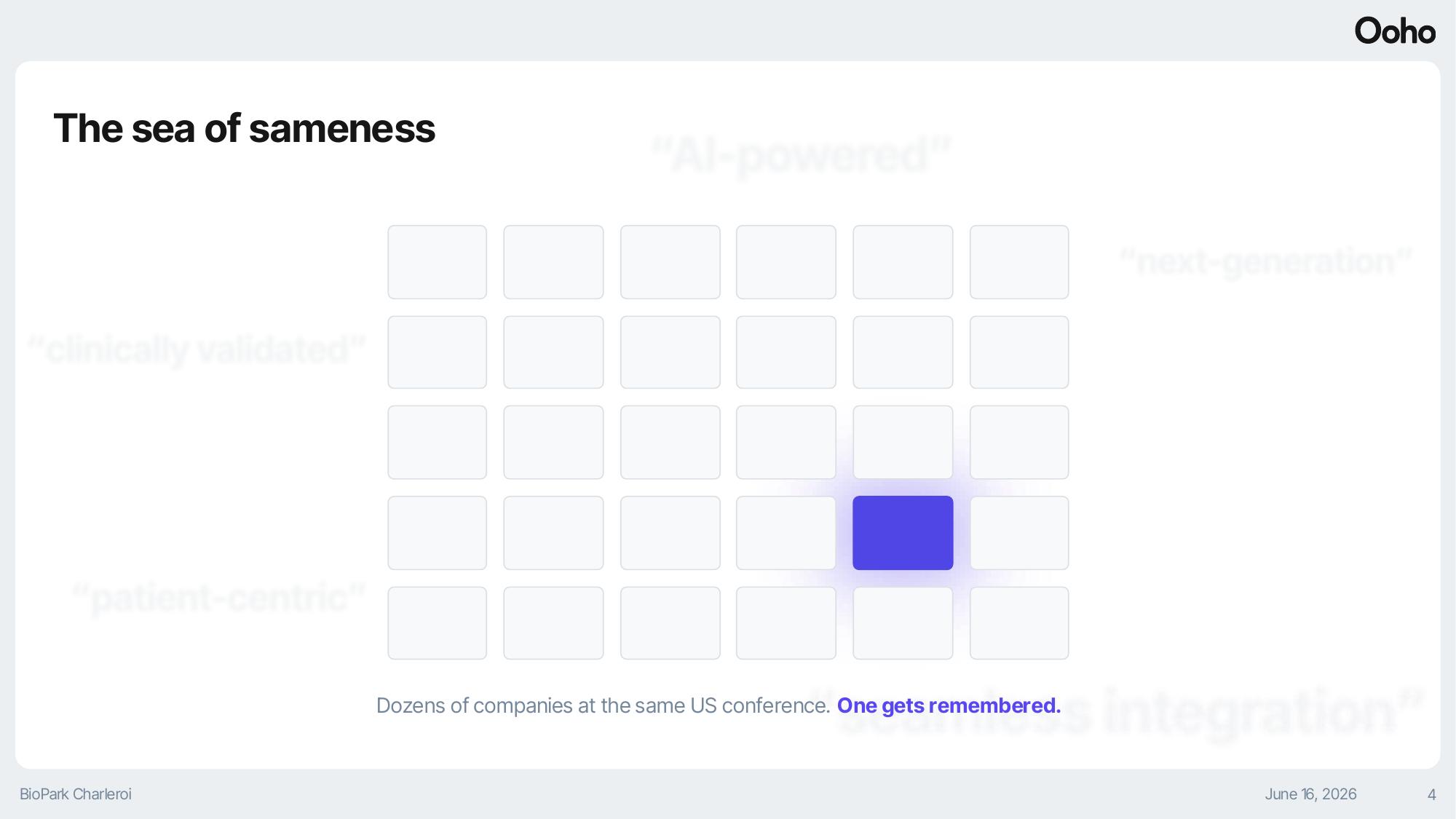
Walk a US medtech conference floor and read the banners. “AI-powered.” “Next-generation.” “Clinically validated.” “Patient-centric platforms that integrate seamlessly with your EMR.” Dozens of companies saying the same four things, and one of them gets remembered.
That is the sea of sameness, and it is the wall most European medtech companies hit on arrival. Not regulatory. Not distribution. Recall. A medical device marketing strategy starts there.
The room you are not in
You will meet the physician who uses your device, and then you leave. What happens next is the actual sale.
A medical director reads your one-pager. IT security asks about data residency. Procurement lines you up against two alternatives while quality and safety works through the QMS file. The CFO's value-analysis committee runs the numbers. Legal reviews the contract. Somewhere near the end, a CEO signs.
Eight people. You were in the room for one of them.
Eight is the conservative version. Gartner and Forrester size a complex buying group at 6 to 16 people across as many as four functions.
Gartner also measured the gap. Buyers spend 17% of a complex purchase with all suppliers combined. Split that across competing vendors and any single rep gets 5% or 6%. The rest of the decision happens in rooms you never enter, with nobody there to explain the difference.
That is what positioning is for. It is a pipeline function, not a brand exercise. Not being memorable at a conference. Being understood in your absence.
Four jobs in one room
Eight people, but not eight jobs. The Miller Heiman model splits a buying committee into four roles, and each one needs something different from your message.
Champions want a relationship. They carry enough internal weight to move things, and they will navigate you to whoever signs. Nurture them.
Users want proof it works in their hands. They care whether it performs on their bench, in their clinic, on their Tuesday. Show them the product doing its job.
Decision makers want a number. Return on investment, in currency, measured against whatever they are paying for today.
Blockers want risk removed. Legal, IT and purchasing arrive late and they are not assessing your science. They are asking whether rollout is clean, whether data is secure, whether GDPR is handled. Hygiene factors, and they kill deals.
One message will not do four jobs.
What positioning is worth
Aerolase builds lasers for skin rejuvenation, out of New York. The company was positioned as a laser instrument provider and came to us with a specific ask: they wanted to charge more.
So we ran a full repositioning, then surveyed end users with the same question before and after. How likely are you to pay $500 out of pocket for this treatment? After the repositioning, they were twice as likely to say yes.
Same device, same treatment, same $500. The only thing that changed was the frame around it.
The effect is not unique to Aerolase. McKinsey found B2B companies with strong brands outperform weak-branded rivals by 20%. A study of 454 US industrial buyers traced it straight to price: credibility raises what a buyer will pay.
Laser beats bazooka
Every go-to-market decision rests on one answer. Who am I selling to?
If the answer is everyone, you will sell to no one. The instinct is to resist narrowing, because picking one slice of the market means giving up the rest of it. You do not need the rest of it yet. You need a beachhead you can grow to five or ten million in revenue, as fast as possible. That is plenty for the first few years.
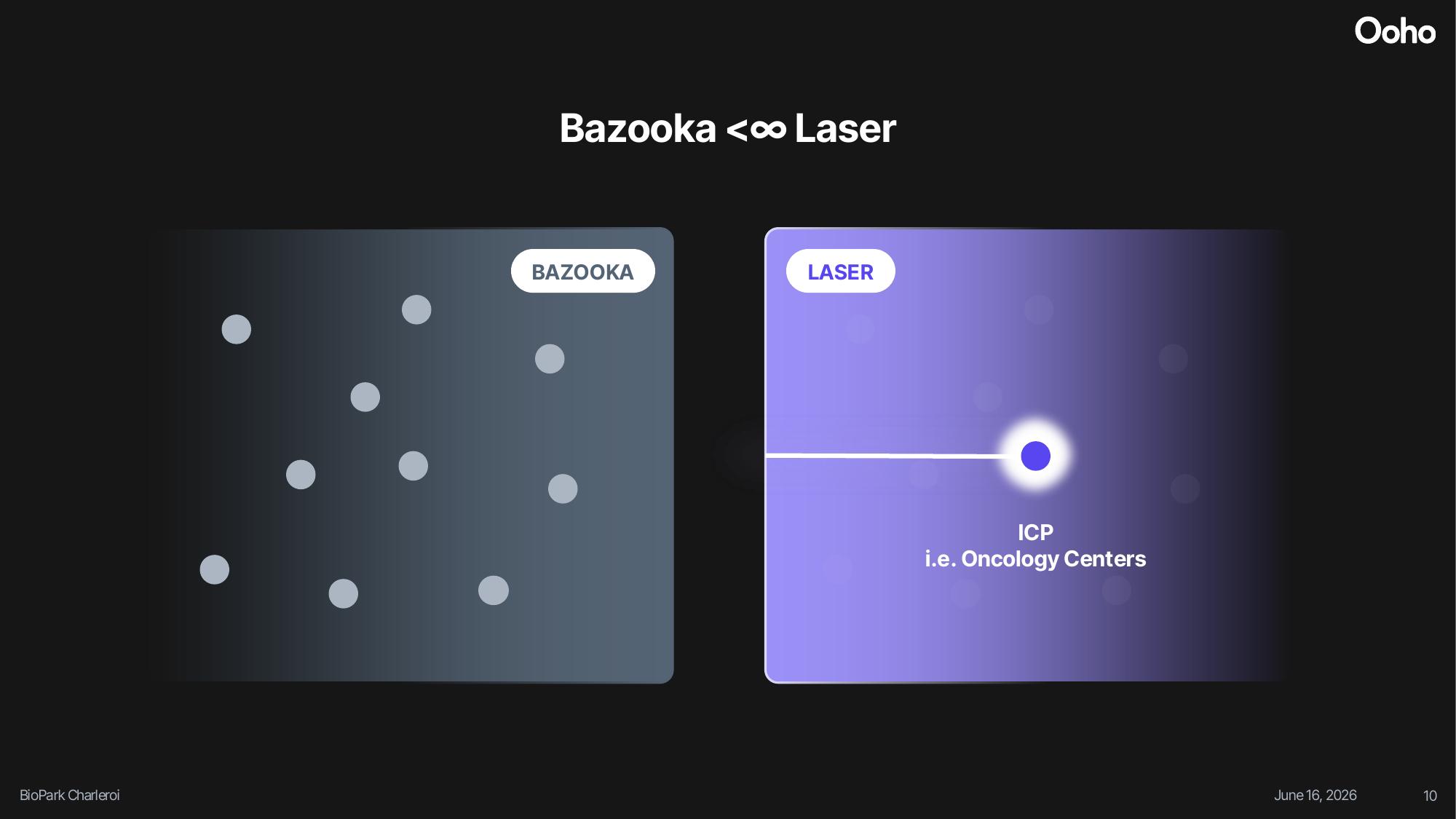
Two things narrow it quickly: where reimbursement codes already exist, and where the need is sharpest. It is the same call the nio+ launch made, cutting four addressable markets down to two.
Then let the list decide what winning means. Sell into five companies, close one, and you hold 20% of your market. Close one out of five hundred and you have a rounding error. Scope the list before you set the target, because the list is the scoreboard.
Build the sentence in three parts
Positioning is always relative to something else, and there are two things to be relative to. Competitive positioning sets you against the current way of doing things, whether that is phone calls, paper protocols or the standard of care. Contextual positioning sets you against a goal the buyer is trying to reach.
Sonovein removes varicose veins with high-intensity focused ultrasound. Vein removal is a crowded market with an established standard of care, so a contextual line would have put them in a queue behind everyone else. We went competitive instead. The alternatives are invasive. A probe goes into the vein to burn it shut or glue it closed. So the line became the one they lead with today: the only non-invasive varicose vein treatment.
Four questions decide the room you are not in. What do you do, who do you do it for, what do you replace, and why is it better than what you replace. Answer all four faster than your competitors and you are ahead of them.
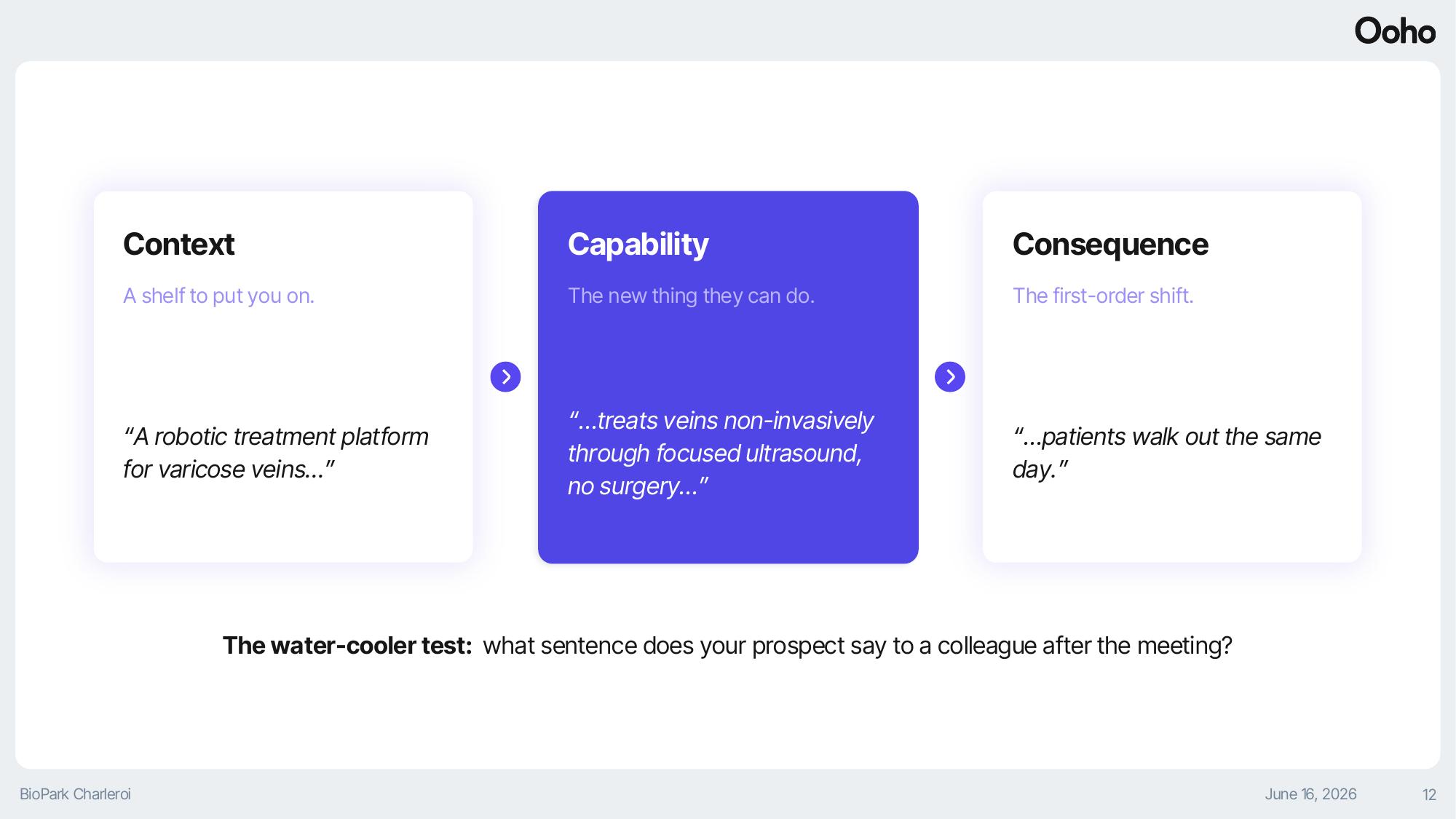
Context gives the buyer a shelf to put you on: a robotic treatment platform for varicose veins. Capability is the new thing they can do: treats veins non-invasively through focused ultrasound, no surgery. Consequence is the shift that follows: patients walk out the same day.
Most companies lead with the consequence, because marketing advice says talk about outcomes. Open there and nobody knows what you do, who it is for, what you replace, or why you are better. Then test it at the water cooler. What sentence does your prospect repeat to a colleague the next morning?
Europe understates. America hears doubt.
Cross-cultural research on communication norms finds that European professionals systematically understate their capabilities. American professionals are expected to state their successes plainly. So “the data looks promising” reads as modesty in Brussels and as hesitation in Boston.
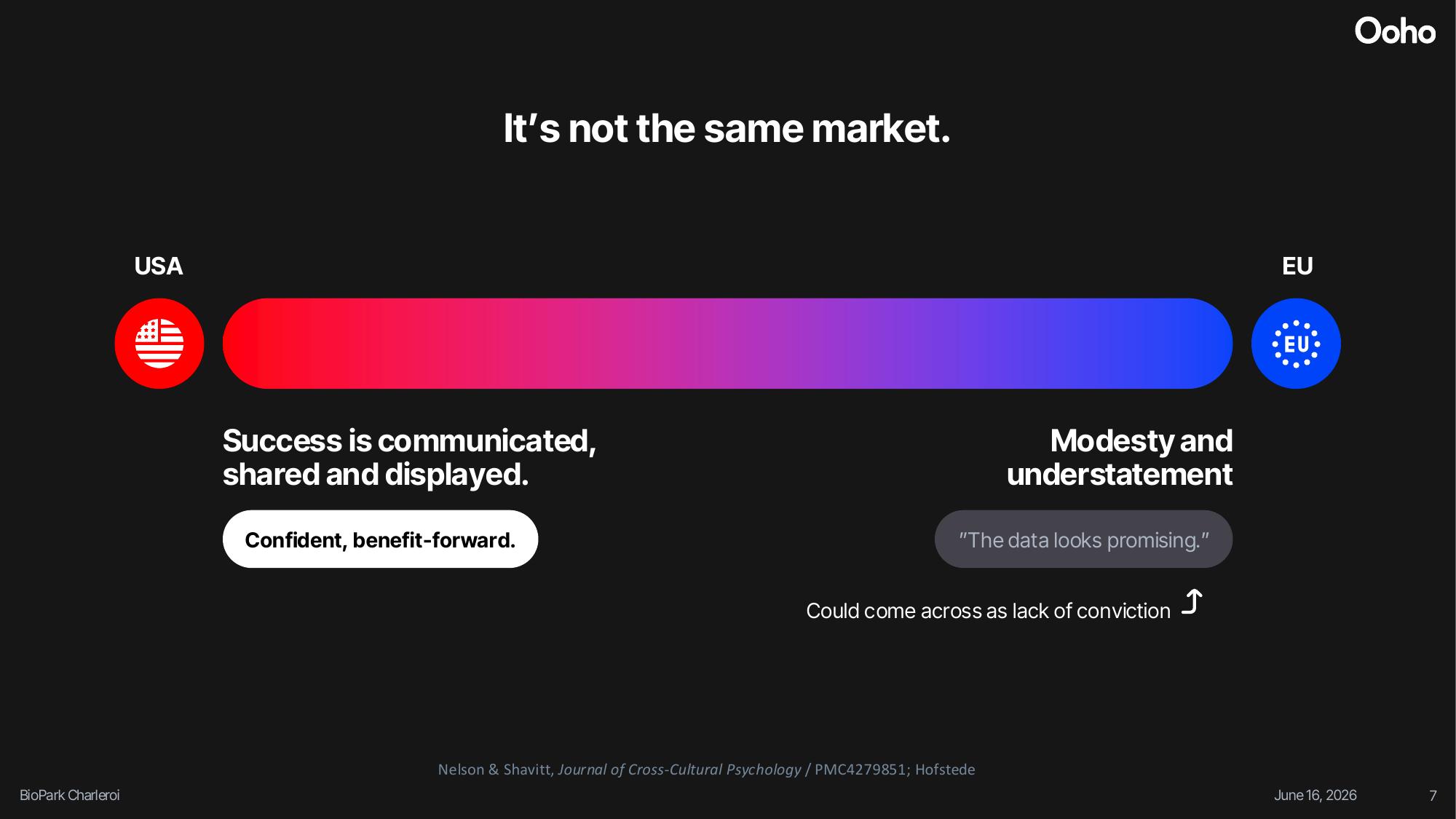
The answer is not to inflate. Read the homepage of an established US player and you will find a superlative with a small number beside it. Follow the number to the bottom of the page. The comparison usually turns out to rest on one spec, measured against a handful of products. Those companies can afford vague copy because they have already won. A company arriving from Europe cannot.
Use the proof you already carry instead. MDR, CE mark, ISO 13485, GDPR with a named DPO, EU clinical evidence. LynxCare, a hospital data platform out of Leuven, treated that stack as a positioning asset and built a compliance centre into the website.
You have already paid for that stack. MedTech Europe found certification costs rose by up to 100% under MDR, and the share of large device makers launching in the EU first fell by a third. A 2025 survey of 267 German manufacturers found most of those who stopped launching in Europe now debut in the US. If the regulation is what pushed you across the Atlantic, make it earn something when you land.
Build your medical device marketing strategy from the personas up
Most companies build messaging top down. Someone writes a vision, the vision becomes a tagline, and the tagline gets pushed onto every audience until it fits none of them.
Run it the other way.
Start with personas, one to four and no more. For each persona, pick three values: the things that person actually wants from a product like yours. Four if you must, but three holds better.
Under each value sits the layer sales will use. A value statement, which is the elevator pitch for that one value. The bullet points that break it apart. The features that deliver it. The proof points that make it credible, which means metrics, case studies and publications. For enterprise deals, add the objections you keep hearing and the answer to each one.
Top-level messaging comes last. The slogan, the elevator pitch, the twenty-five word version. You build those up from what the personas told you. You do not hand them down.
Write it down, or it becomes a roll-up banner
Thibault asked the room for a show of hands. Who keeps a centralised messaging playbook and actively uses it? Very few hands went up.
Without one, positioning becomes a last-minute job. Three days before a conference deadline, someone asks what goes on the roll-up banner. The answer comes off the website. The website has said the same thing for two years.
The waste shows up further down. SiriusDecisions found 60% to 70% of B2B sales content goes unused. Material written for no particular persona, without the sales team in the room, sits on a shelf.
A playbook fixes that. Messaging flows down into the website, landing pages, ads, sales decks, webinars and events. Customer quotes and field feedback flow back up into it. It stays a living document, reviewed with sales. Not a PDF that ships once.
That review is also how you test the messaging. In medtech you get dozens of conversations, not thousands, so the evidence is qualitative by nature. Sit with the sales team and ask three things. Are the messages landing? Does anyone misread what we mean? Are we talking about the concepts that matter to them? Where you do have web traffic, test comprehension on the page before you put budget behind it.
Frequently asked questions
How many people are involved in a medtech buying decision?
Gartner and Forrester size a complex B2B buying group at 6 to 16 people across up to four functions. In a hospital, expect at least eight: the user, a medical director, IT security, procurement, quality and safety, the value-analysis committee, legal and the CEO.
What is the context, capability, consequence framework?
It is a three-part positioning sentence. Context gives the buyer a shelf to put you on. Capability names the new thing they can do. Consequence is the shift that follows. Test it by asking what a prospect would repeat to a colleague the next morning.
How should European medtech companies adapt their messaging for the US?
State results plainly, because American buyers read understatement as doubt. Avoid inflated claims. Lead with the proof you already carry: MDR, CE mark, ISO 13485, GDPR with a named DPO and EU clinical evidence.
What is a messaging playbook?
A living document that holds your positioning per persona: one to four personas, three values each, with value statements, features, proof points and objection handling. Messaging flows from it into the website, ads and sales decks, and field feedback flows back into it.
Start with the four questions
If you are taking a medical device or diagnostic into the US as a startup, and your messaging is whatever the website said two years ago, start there. What do you do, who for, what do you replace, why is it better.
Or send us the deck you plan to pitch with, and we will tell you which of the four it fails.
Drawn from two Ooho sessions on positioning: Thibault Vandenhove at BioPark Charleroi, and Tom Claes on messaging frameworks for healthtech.
Let’s get in touch.
We build brands that make your science impossible to overlook, and worth more once it’s understood. Let’s talk about your rebrand.